Academic Task 1
How to describe a table in IELTS Task 1
A table can hold dozens of figures, so the real skill is selection, not transcription. You choose the highest and lowest values, the clearest comparisons, and the overall pattern, then report only those. This guide shows you how, with phrases you can reuse under exam pressure.
In short
- Select, do not list. Pick the highest and lowest figure per row or column and the sharpest comparisons.
- Write an overview of the standout patterns straight after the introduction, with no specific numbers.
- Group similar data into two body paragraphs and write at least 150 words in about 20 minutes.
Selection is the whole task
A table is just a grid of numbers, and that is exactly the trap. A weak answer reads the cells left to right and turns each one into a sentence, which produces a flat list and a low Coherence and Cohesion score. A strong answer reads the table first, looks for the extremes, and reports only what matters.
Before you write, scan in two directions. Read each row across to find the biggest and smallest value in that category, then read each column down to compare categories at the same point. Mark the highest figure, the lowest figure, and any value that breaks the pattern. Those marks become your content; everything else stays in the table.
A useful rule of thumb: if a sentence does not name a maximum, a minimum, a clear comparison, or a change over time, it probably does not earn marks. Two or three exact figures per paragraph are enough to show you can quote data accurately.
A four-part structure that fits 20 minutes
Tables suit the same shape as any Academic Task 1 answer. Keep it to four parts so you finish on time and leave room to check tenses.
- Introduction. Paraphrase the prompt. Change the wording, not the meaning: "The table compares..." or "The table shows figures for...".
- Overview. State the two or three biggest patterns with no numbers, for example which category is largest overall or whether values rose or fell.
- Body paragraph 1. Take one logical group, perhaps the leading categories, and support it with exact figures and a comparison.
- Body paragraph 2. Cover the remaining group, the lowest values, or the clearest change between time points.
Group by meaning, not by position. If a table lists five countries, you might group the top two performers in one paragraph and the rest in the other, rather than working down the rows in the order they appear.
Language for selecting and comparing
Lexical Resource and Grammatical Range and Accuracy both improve when you vary how you point to high and low values. The table below pairs a flat phrasing with a stronger version you can lift into your own answer.
| Purpose | Flat (band 5–6) | Selective (band 7+) |
|---|---|---|
| Highest value | Country A was 80, which is big. | Country A recorded the highest figure, at 80 percent. |
| Lowest value | Country D was only 12. | The lowest proportion, just 12 percent, was seen in Country D. |
| Comparison | A was more than B. | A was roughly twice as high as B, at 80 against 38. |
| Change over time | It went up from 2000 to 2010. | The figure climbed from 45 in 2000 to 62 in 2010. |
| Grouping similar data | B and C were the same kind of. | B and C followed a similar pattern, both sitting near 40 percent. |
| Exception | But E was different. | Country E was the only exception, falling rather than rising. |
Approximation words such as "roughly", "just under", and "around" let you summarise without quoting every decimal, which keeps you inside 20 minutes. When a table mixes dated and undated columns, check the tense for each part: past years take the past tense, projected years take future forms, and undated current data takes the present.
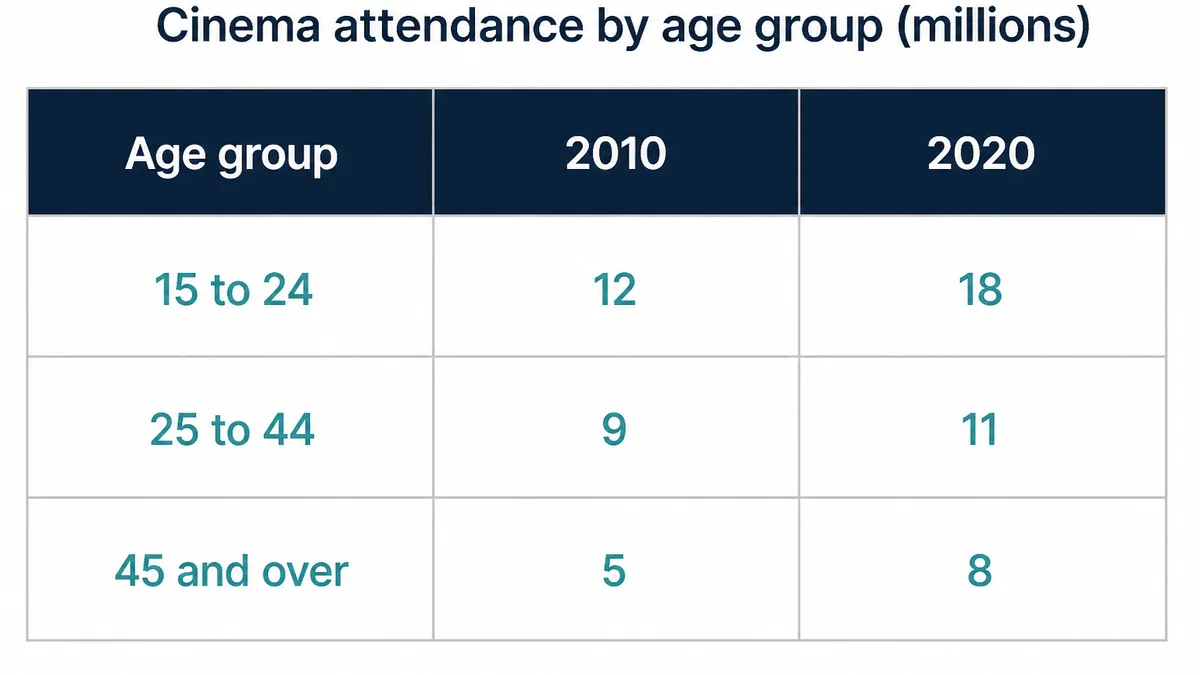
Worked example
IELTS Task 1 table: common questions
How do I describe a table in IELTS Task 1?+
Read the rows and columns, then select the highest and lowest figures and the clearest comparisons. Write an overview of the main patterns, then group similar data into two body paragraphs. Do not describe every cell.
Do I need to mention every number in a table?+
No. Tables often hold dozens of figures and reporting them all wastes time and hurts Coherence & Cohesion. Choose the standout values and trends, support them with a few exact figures, and leave the rest.
How long should an IELTS Task 1 table answer be?+
At least 150 words, written in about 20 minutes. Aim for roughly 160–190 words: an introduction, an overview sentence, and two body paragraphs that group and compare the key data.
What tenses do I use for a table?+
Match the tense to the dates given. Use past tense for past years, present tense for undated or current data, and future forms for projected years. Mixed-period tables need more than one tense.
Where do I write the overview for a table?+
Right after the introduction. The overview states the two or three biggest patterns, such as the largest category or the overall direction of change, without specific numbers. Examiners reward a clear overview under Task Achievement.