IELTS Academic Task 1
How to describe a bar chart in IELTS Task 1
A bar chart compares quantities across categories or over time. The skill examiners reward is not listing every bar, but selecting and grouping the biggest, the smallest and the clearest contrasts, then reporting them with accurate comparative language.
In short
- Open with a paraphrase, then a one or two sentence overview naming the highest and lowest categories.
- Group bars by size or pattern instead of describing each one in turn.
- Use superlatives, comparatives and approximation to vary your Lexical Resource and Grammar.
A four-paragraph structure that works
Every strong bar chart answer follows the same shape. Examiners mark Task 1 on four criteria: Task Achievement, Coherence & Cohesion, Lexical Resource, and Grammatical Range & Accuracy. A clear structure earns marks on the first two and gives you room to show the second two.
- Introduction. Paraphrase the chart title and axes. Change words and structure, for example "The bar chart compares" becomes "The graph illustrates the difference in".
- Overview. State the most noticeable features in one or two sentences, with no numbers, for example which category is highest and the overall pattern.
- Body paragraph 1. Detail the largest group of bars with supporting figures.
- Body paragraph 2. Detail the smaller or contrasting group, and any bars that share a value.
Keep the whole answer to at least 150 words, ideally 160 to 190, written in about 20 minutes so you leave 40 minutes for the longer Task 2 essay.
Group and select, do not list
The single most common mistake is treating a bar chart as a list and walking through every bar from left to right. That produces a flat answer with no overview and a low Task Achievement score. Instead, look for relationships before you write.
Ask three questions of the chart: which category is the highest, which is the lowest, and which bars are close to each other or move in the same direction. Those answers become your grouping. For a chart of leisure spending by age, you might group "the two youngest groups, who spent the most" against "older respondents, whose spending fell steadily".
When a chart shows years rather than categories, describe change over time: "rose sharply", "remained stable", "more than doubled". When it shows separate categories, describe difference: "far higher than", "roughly equal to", "the second smallest". Reading the axis correctly decides which language set you reach for.
Comparative, superlative and approximation language
Bar charts reward precise comparison. Mixing exact figures with approximation shows range and stops your answer reading like a price list. The table below pairs a flat band 6 phrasing with a sharper band 7 version using the same data point.
| Function | Flatter phrasing (band 6) | Sharper phrasing (band 7) |
|---|---|---|
| Highest value | Germany was the biggest at 80 percent. | Germany recorded the highest figure, at just over four fifths. |
| Lowest value | Spain was the lowest at 19 percent. | Spain stood at the bottom, with roughly one in five. |
| Comparison | France was more than Italy. | France was almost twice as high as Italy. |
| Approximation | The figure was about 48 percent. | The figure stood at just under a half. |
| Similar values | The UK and Poland were the same. | The UK and Poland were broadly comparable, at around 30 percent each. |
Approximation words to keep ready: just over, just under, roughly, around, approximately, nearly, well over. Fractions such as a third, two fifths and three quarters often read more naturally than the raw percentage and add variety to your Lexical Resource.
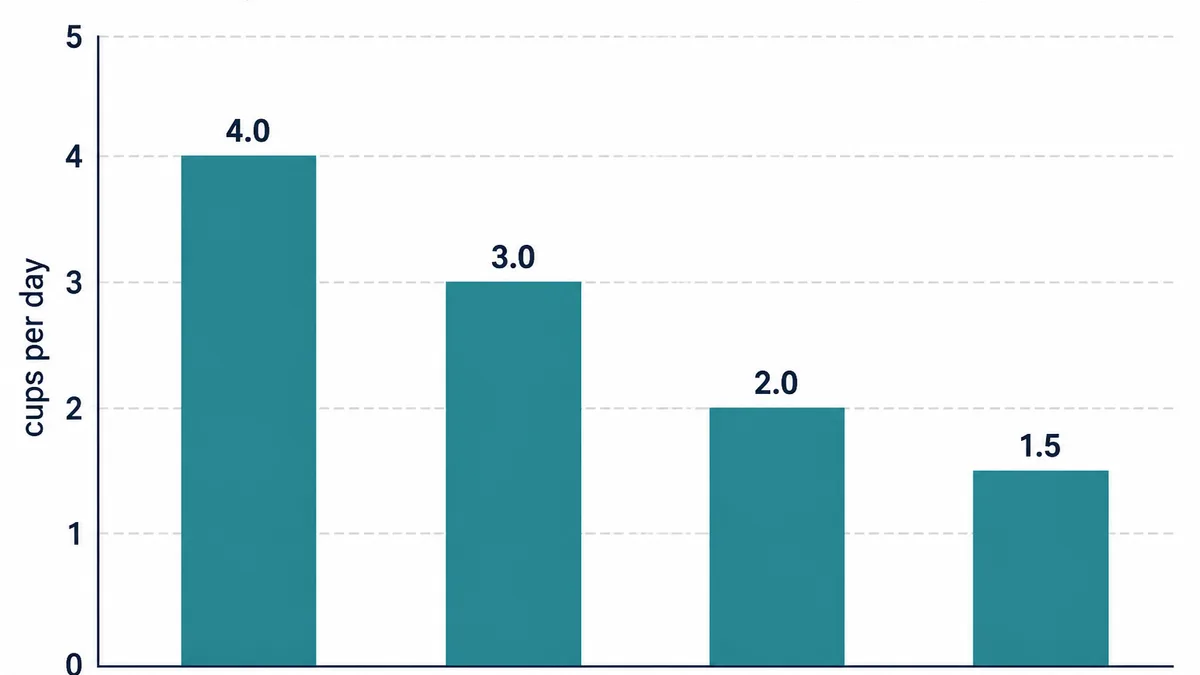
Worked example
IELTS Task 1 bar chart FAQs
How do I describe a bar chart in IELTS Task 1?+
Paraphrase the question, write a one or two sentence overview of the biggest trends, then two body paragraphs grouping the highest, lowest and any striking comparisons. Use comparative and superlative language with approximation. Aim for at least 150 words in about 20 minutes.
Should I describe every bar in a bar chart?+
No. Listing every bar reads as a data dump and loses marks. Select and group the key features: the largest and smallest categories, any that share a value, and the clearest contrasts. Reporting all the data accurately is a skill of selection, not completeness.
What is the overview in a bar chart task?+
The overview is one or two sentences stating the most noticeable features without specific numbers, for example which category is highest and the general pattern. A clear overview is essential for band 7 on Task Achievement; answers with no overview are capped lower.
Do I use past or present tense for a bar chart?+
Match the tense to the dates. Use past tense when the chart shows a finished year, present tense when it shows no time or a general state, and future forms only if the chart projects forward. Mixing tenses without reason affects Grammatical Range & Accuracy.
How many words should a bar chart answer be?+
At least 150 words. Writing under 150 is penalised under Task Achievement, so aim for roughly 160 to 190 words. That is enough to cover an overview and two grouped body paragraphs without padding or repeating the same comparison.