IELTS Academic Task 1
How to describe a process diagram in IELTS Task 1
A process diagram shows the stages of a natural or manufacturing process, usually with no numbers to report. The skill examiners reward is counting the stages, stating where the process starts and ends, then sequencing each step with clear linkers and the passive voice.
In short
- Count the stages, then say in the overview how many there are and whether the process is a cycle or linear.
- Describe the steps strictly in order using first, next, subsequently and finally.
- Use the passive voice and the present simple, since most processes have no named actor.
A four-paragraph structure that works
A process diagram answer follows the same shape as any Task 1 response. Examiners mark Task 1 on four criteria: Task Achievement, Coherence & Cohesion, Lexical Resource, and Grammatical Range & Accuracy. A clear, ordered structure earns marks on the first two and gives you room to show the second two.
- Introduction. Paraphrase the diagram title. Change words and structure, for example "The diagram shows how cement is made" becomes "The illustration depicts the stages involved in producing cement".
- Overview. State the number of stages, where the process begins and ends, and whether it is a one-way sequence or a continuous cycle. Carry no fine detail here.
- Body paragraph 1. Describe the first half of the stages in order, from the starting input to the midpoint.
- Body paragraph 2. Describe the remaining stages through to the final output, or back to the start if the process is a cycle.
Keep the whole answer to at least 150 words, ideally 160 to 190, written in about 20 minutes so you leave 40 minutes for the longer Task 2 essay.
Count the stages and find the overview
Process tasks rarely give you numbers, so your overview cannot rest on the highest or lowest figure. Instead it rests on shape. Before you write, count the stages and answer two questions: where does the process start, and where does it end. The number of steps and the start and end points become your overview.
Decide whether the process is linear or cyclical. A linear process runs from a raw input to a finished product, for example raw clay through to fired bricks. A cyclical process returns to its starting point, for example the life cycle of a frog or the water cycle, where the final stage feeds back into the first. Naming the cycle in your overview is an easy way to show you have read the whole diagram.
A model overview reads: "Overall, the process consists of seven distinct stages, beginning with the harvesting of raw cane and ending with the packaging of refined sugar." That single sentence names the count, the start and the end, which is exactly what Task Achievement rewards at band 7.
Sequence linkers and the passive voice
Two language features carry a process answer: linkers that signal order, and the passive voice for steps with no named actor. Rotate your linkers so you do not open every sentence with "then", and keep the present simple unless the diagram is clearly set in the past. The table below maps the function you need to the language that delivers it.
| Stage in the process | Linkers to use | Passive example |
|---|---|---|
| First stage | To begin with, In the first stage, Initially | To begin with, the raw beans are harvested by hand. |
| Middle stages | Next, After this, Subsequently, Once X is done | Subsequently, the beans are dried and then roasted at high temperature. |
| Simultaneous steps | At the same time, Meanwhile, While this occurs | Meanwhile, the husks are separated and set aside for compost. |
| Final stage | Finally, In the last stage, Lastly | Finally, the ground coffee is sealed and packaged for sale. |
| Return of a cycle | At which point the cycle repeats, before the process begins again | The young then mature, at which point the cycle repeats. |
Reach for the active voice only when a natural process has a clear agent, for example "the salmon swims upstream to spawn". Everywhere else the passive keeps the focus on the stage rather than an invisible worker, which is exactly the register examiners expect in a process description.
Worked example
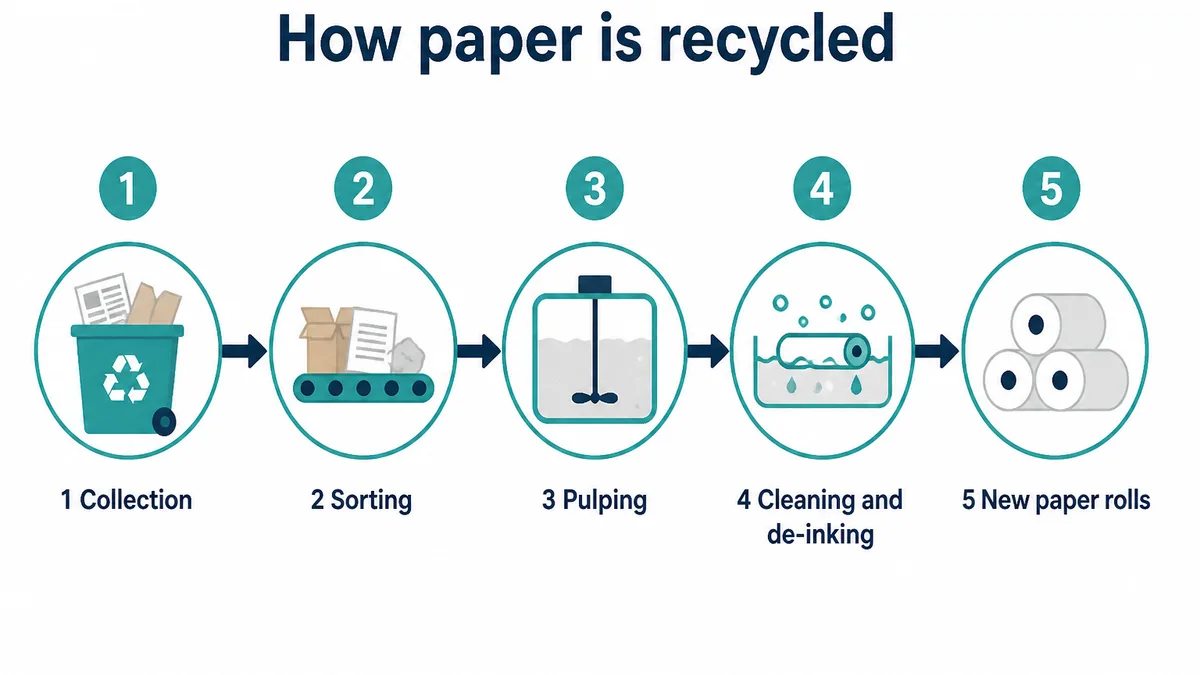
IELTS Task 1 process diagram FAQs
How do I describe a process diagram in IELTS Task 1?+
Paraphrase the title, count the stages, and write an overview stating how many steps there are and whether the process is a cycle or linear. Then describe each stage in order using sequence linkers and the passive voice. Aim for at least 150 words in about 20 minutes.
What goes in the overview of a process diagram?+
The overview names the total number of stages, where the process begins and ends, and whether it forms a continuous cycle or a one-way sequence. It carries no fine detail. A clear overview is needed for band 7 on Task Achievement, and answers without one are capped lower.
Do I use the passive voice for a process diagram?+
Usually yes. Most manufacturing and treatment processes have no named actor, so the passive fits naturally, for example the clay is shaped or the water is filtered. Use the active voice only for natural processes driven by a clear agent, such as the salmon swims upstream.
Which tense should I use for a process diagram?+
Use the present simple for a process happening in general, which covers almost every diagram, for example the beans are roasted. Use the past simple only if the diagram is clearly set in the past. Process tasks rarely carry numbers, so tense, not data, is the focus.
How many words should a process diagram answer be?+
At least 150 words. Writing under 150 is penalised under Task Achievement, so aim for roughly 160 to 190 words. That is enough to cover an overview and every stage in order without padding or repeating the same linker.