Academic Task 1 question types
How to describe a map in IELTS Task 1
An IELTS Task 1 map almost always shows one place at two points in time, and your task is to describe how it changed. The skill is reporting what was added, removed, relocated, or expanded using the passive voice and clear location language. This guide shows you the structure, tenses, and exact phrases that score well.
In short
- A map task compares one place across two times, so describe the changes, not static facts.
- Use the passive voice for changes: a marina was built, the forest was cleared, houses were demolished.
- Locate every feature with compass and position language: to the north, adjacent to, in the south-east corner.
What the examiner wants you to report
A map question gives you two diagrams of the same area, usually labelled with years or with "now" and a future plan. The four marking criteria are Task Achievement, Coherence & Cohesion, Lexical Resource, and Grammatical Range & Accuracy. For a map, Task Achievement rewards you for grouping and summarising the real changes, so first scan both maps and ask four questions:
- What was added that did not exist before (a hotel, a road, a car park)?
- What was removed or demolished (trees, an old building, a farm)?
- What was relocated or replaced (the shop became a restaurant, the path moved east)?
- What was expanded or stayed the same (the town grew, the river was unchanged)?
Write at least 150 words in around 20 minutes. There are no numbers to report, so accuracy here means accurate locations and accurate verbs, not data. Never give an opinion or guess why the changes were made.
A four-paragraph structure that works
Maps reward a simple, consistent plan. Use four short paragraphs and your reader never gets lost:
- Introduction. Paraphrase the question. "The two maps illustrate the development of the coastal town of Bridgeton between 1990 and the present day."
- Overview. State the big picture in general terms. "Overall, the area was transformed from a largely rural settlement into a developed tourist resort, with most green space giving way to amenities."
- Body 1. Group several related changes, often by area (for example the north and the coastline).
- Body 2. Cover the remaining changes (the south, the centre, anything left unchanged).
Grouping changes geographically, rather than describing the maps one at a time, is what lifts Coherence & Cohesion. Signal each new area with a position phrase so the examiner can follow the layout without seeing the picture.
Passive voice and location language
Changes to a place are usually expressed in the passive, because the agent (the planners) is unknown or irrelevant. This shows Grammatical Range & Accuracy and sounds natural. Pair each change verb with a location phrase so the reader knows where it happened.
Worked sentences: "In the north of the area, the farmland was replaced by a residential estate." "A small marina was constructed to the east, adjacent to the existing harbour." "The woodland that once stood in the centre was cleared to make way for a shopping complex." "The railway line in the south remained unchanged throughout the period."
Use the table below to build accurate change and location phrases.
| Type of change | Passive verb to use | Location phrase to add |
|---|---|---|
| Something new appears | was built, was constructed, was added, was set up | to the north, in the south-east corner |
| Something disappears | was demolished, was removed, was cleared, was knocked down | on the western edge, beside the river |
| One thing becomes another | was replaced by, was converted into, was turned into | in the town centre, where the school stood |
| Something moves | was relocated, was moved, was extended | further inland, closer to the coast |
| Something grows | was expanded, was enlarged (or active: grew, expanded) | across the surrounding fields, to the south |
| Something stays | remained unchanged, was retained, was left untouched | in the same position, next to the main road |
A quick note on tense: if both maps are in the past, use the past simple throughout. If one map is the present, contrast past with present (the field was open land, but it is now built up). For a present-to-future plan, switch to future forms such as will be built or is going to be relocated.
Worked example
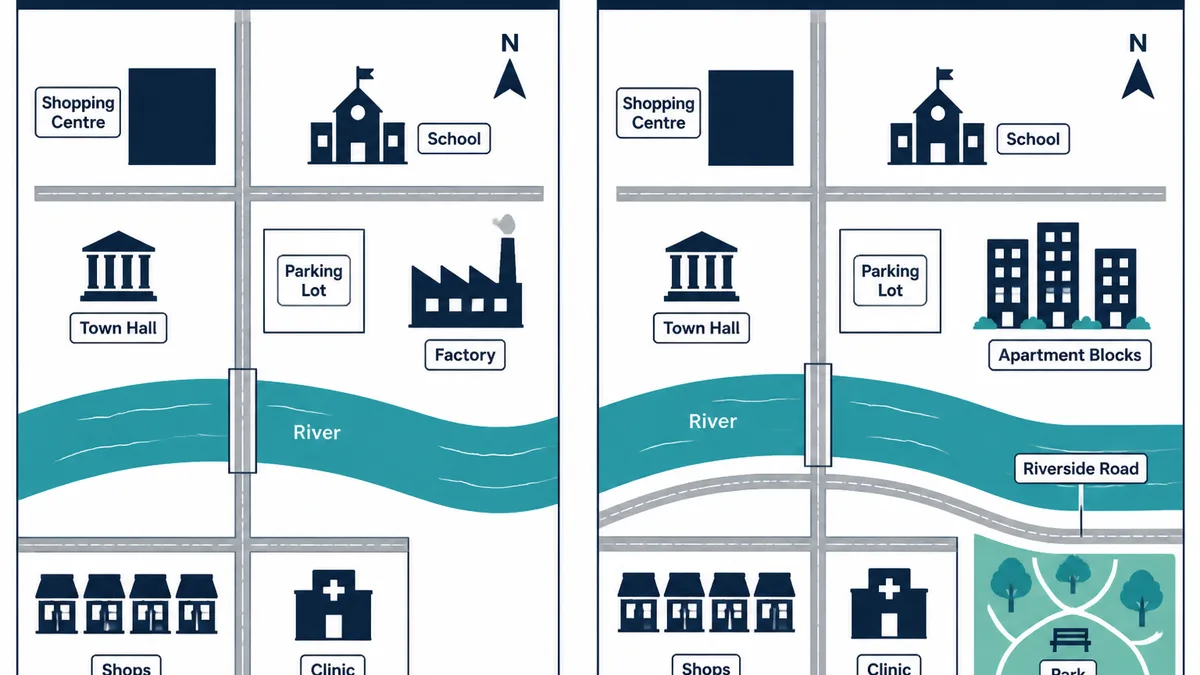
IELTS Task 1 map: common questions
What does an IELTS Task 1 map question usually show?+
Most map tasks show one place at two different times, often labelled past and present or present and future. Your job is to describe how the area changed: what was added, removed, relocated, or expanded between the two maps.
Should I use the passive voice for an IELTS Task 1 map?+
Yes, frequently. Changes happen to the place, so the passive fits naturally: a hospital was built, the woodland was cleared, the car park was replaced by flats. Mix in active verbs for things that grew or remained to keep your grammar varied.
Which tenses do I use for a map describing change?+
Use the past simple if both maps are in the past, or a past-to-present contrast (was, then becomes is) when one map is now. For a present-to-future map, use future forms such as will be built or is going to be relocated. Stay consistent.
How many words should an IELTS Task 1 map answer be?+
Write at least 150 words. Aim for roughly 160 to 190 in about 20 minutes. Fewer than 150 words is penalised under Task Achievement, so cover every major change rather than describing one corner in detail.
Do I need an overview in a map answer?+
Yes. The overview is essential for Task Achievement. State the main changes in general terms, for example that the area shifted from rural to residential, without listing every detail or any specific figures.