How to Finish IELTS Writing Task 2 in 40 Minutes
An IELTS writing Task 2 time management plan that splits your 40 minutes into planning, writing, and checking — with the minute-by-minute breakdown examiners never see you skip.
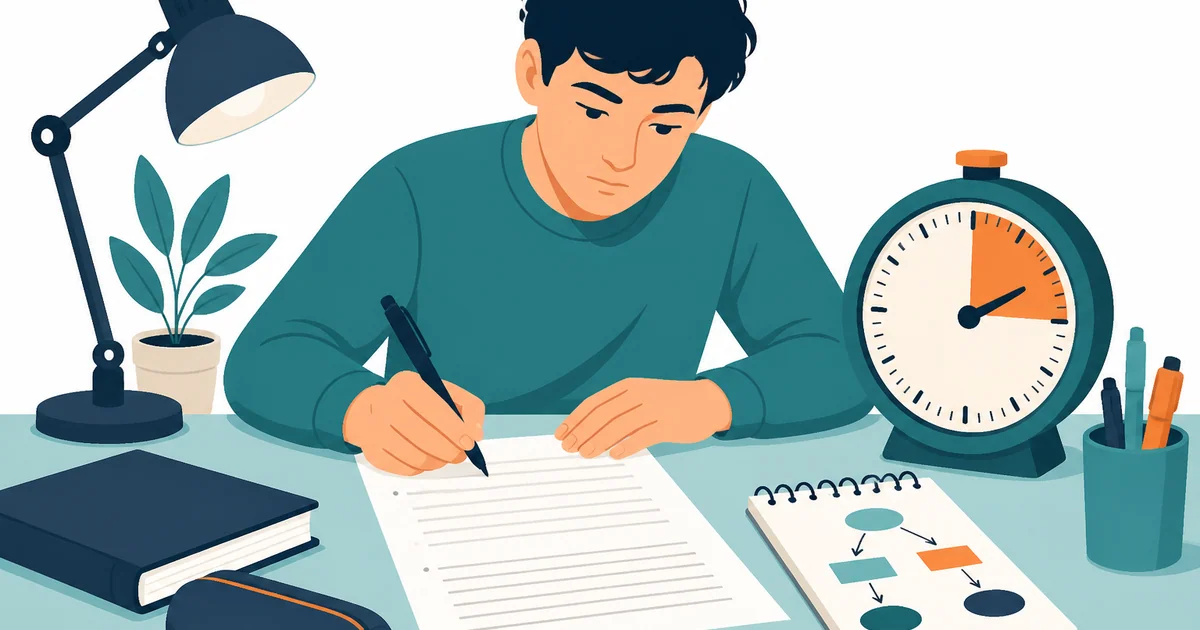
Forty minutes feels tight the first time you sit a full IELTS Writing test, and it feels tighter the moment you realise Task 2 is worth twice as much as Task 1 toward your overall Writing band. Good IELTS Writing Task 2 time management isn’t about writing faster — it’s about deciding in advance how the 40 minutes gets spent, so you’re never discovering with five minutes left that you haven’t planned a conclusion. This post gives you the minute-by-minute breakdown, why each phase needs the time it needs, and what to do when the clock runs down faster than expected.
What Is the Best Way to Manage Time on IELTS Writing Task 2?
The 40 minutes for IELTS Writing Task 2 splits into three phases: roughly 5 minutes planning, 30 minutes writing, and 5 minutes checking. Planning means reading the question carefully, deciding your position, and outlining three or four paragraphs before writing a single sentence of the essay itself. The 30 minutes of writing covers a short introduction (3-4 minutes), two or three body paragraphs (roughly 8-10 minutes each), and a brief conclusion (2-3 minutes). The final 5 minutes go to checking specifically for grammar, spelling, and whether every part of the question was actually answered — not re-reading for general impressions. This split isn’t arbitrary: skipping planning to “save time” is the single most common cause of essays that drift off-topic or run out of ideas halfway through, which costs far more time and Task Response marks than the 5 minutes it would have taken to plan.
Why Do I Keep Running Out of Time on Task 2?
Most candidates who run out of time haven’t misjudged how long 40 minutes is — they’ve spent it unevenly. The two most common patterns: writing without a plan, which leads to a strong first body paragraph followed by a second one that repeats the same point in different words because the essay ran out of distinct ideas; and treating the first draft as final, so every sentence gets reworded three times while it’s being written instead of once at the end. Both patterns eat into the checking phase first, then the conclusion, which is why so many band 6 essays end abruptly on the second body paragraph with no conclusion at all — a problem the Task Response criterion penalises directly, since a response has to be complete to be fully assessed, not just accurate for as far as it goes.
The Minute-by-Minute Breakdown
- Minutes 0-2 — Read and analyse the question. Identify the question type (opinion, discussion, problem-solution, or two-part) and underline every part you’re required to address. Two-part questions are where marks get lost fastest, because it’s easy to answer only the part that’s easiest to write about.
- Minutes 2-5 — Brainstorm and outline. Choose two or three main ideas — not five — and write a one-line plan for each paragraph: topic sentence, one example, one explanation. A plan you can’t summarise in one line per paragraph is still too vague to write from quickly.
- Minutes 5-9 — Introduction. Paraphrase the question in one or two sentences, then state your position or preview your response clearly. This is the shortest paragraph and should not take longer than 4 minutes.
- Minutes 9-19 — Body paragraph one. Topic sentence, explanation, one specific example, and a closing sentence that ties back to the topic sentence. Ten minutes is enough for a full paragraph if you’re writing from your one-line plan rather than composing ideas as you go.
- Minutes 19-29 — Body paragraph two. Same structure as paragraph one, on a genuinely distinct idea — not a restatement of paragraph one with different vocabulary.
- Minutes 29-33 — Conclusion. Restate your position and briefly summarise your main points. No new ideas or examples belong here — a conclusion that introduces a new argument this late usually looks unplanned, because it is.
- Minutes 33-38 — Check for errors. Read once specifically for grammar (verb tense, subject-verb agreement, articles), once for spelling, and confirm every part of the original question got a direct answer.
- Minutes 38-40 — Final word count check. Confirm you’re at or above 250 words. Falling under the word-count minimum is penalised directly, separately from any grammar or content issue, so this check takes ten seconds and is worth doing even under time pressure.
Planning Time vs. Writing Time: Where Band 6 and Band 7 Candidates Actually Differ
The gap between a band 6 and a band 7 essay is rarely about writing speed — both candidates finish in roughly 40 minutes. It’s about where the time went before the writing started.
| Typical Band 6 approach | Typical Band 7 approach | |
|---|---|---|
| Planning | Under 2 minutes, or skipped entirely | 4-5 minutes, with a written outline |
| Body paragraph ideas | Chosen while writing, sometimes overlapping | Chosen in advance, kept distinct |
| Conclusion | Often missing or added in the last 60 seconds | Planned as its own step, 2-3 minutes |
| Checking | Skipped, or a single quick re-read | 5 minutes, targeted at specific error types |
| Result under time pressure | Essay ends abruptly or repeats ideas | Essay stays on plan even if rushed near the end |
The British Council, IDP: IELTS Australia, and Cambridge Assessment English band descriptors don’t score how the 40 minutes was spent directly, but every column on the right side of that table maps onto something the descriptors do score: a complete response (Task Response), a clear paragraph structure with a logical progression of ideas (Coherence & Cohesion), and fewer slips introduced by rushed, unplanned writing (Grammatical Range & Accuracy). Time management is the mechanism; the band descriptors are what actually get marked.
What If the Clock Runs Out Before You’re Done?
If you’re inside the last 5 minutes and still writing your second body paragraph, finish the sentence you’re on, close the paragraph with a short final sentence, and move straight to a brief conclusion — even two sentences restating your position are worth more under Task Response than no conclusion at all, because an essay that never reaches its own conclusion reads as structurally incomplete regardless of how strong the body paragraphs were. Don’t use the remaining time to go back and improve vocabulary in paragraph one instead of finishing the essay; an unfinished response is capped more heavily than one with a plain but complete ending. This is also the scenario the Task 2 structure guide plans around directly — building each paragraph to a fixed, predictable shape specifically so it can be shortened under pressure without falling apart.
Habits That Quietly Waste Minutes You Don’t Notice Losing
Beyond the phase breakdown, a handful of small habits eat minutes without feeling like they’re costing you anything at the time:
- Composing sentences in your first language and translating them. This roughly doubles the thinking time per sentence and tends to produce awkward, literal phrasing that costs Lexical Resource marks on top of the time lost. Practising to think and plan directly in English, even in rough note form, removes this step entirely.
- Counting words repeatedly during writing. Stopping every few sentences to count how close you are to 250 words breaks concentration and adds up to real minutes across an essay. Learn roughly how many words your handwriting or typing produces per line so you can estimate at a glance instead.
- Rewriting a sentence mid-draft instead of finishing the paragraph. Perfecting word choice while the sentence is still being written interrupts the flow of the argument and is exactly what the 5-minute checking phase at the end is for. A slightly awkward sentence written once and revisited later costs less time overall than the same sentence reworded three times as it’s produced.
- Over-elaborating the introduction. An introduction that tries to include background context, a thesis, and a preview of every body paragraph point usually runs past 4 minutes and past what the introduction actually needs to do, which is simply paraphrase the question and state a clear position.
- Choosing an example mid-sentence instead of in the plan. If your one-line outline for a paragraph doesn’t already name the specific example you’ll use, you end up pausing mid-paragraph to think of one — precisely the kind of pause the planning phase exists to prevent.
None of these habits are large individually, but candidates who consistently run out of time are usually losing it in several small places like these rather than in one obvious spot, which is why timing full practice essays — not just reading about the ideal split — is what actually surfaces them.
Practising the Split, Not Just the Essay
Reading a time breakdown is easy; holding to it under real exam pressure, with a topic you didn’t choose, is a different skill — and it’s one that’s hard to build without timing yourself against a real clock on a full essay, not a paragraph in isolation. Most candidates who consistently run short on time have never actually measured which phase eats their minutes; they only know the overall result (“I didn’t finish”), not the cause. Timing three or four full practice essays and noting where each one actually finished each phase — not where you meant to — is usually enough to reveal a specific, fixable pattern, whether that’s over-planning, an overlong first body paragraph, or checking that never happens at all.
If you want to know how your own timed essays would actually score against the four IELTS Writing criteria — including whether a rushed ending or a missing check-through is costing you Task Response or Grammatical Range & Accuracy marks specifically — our IELTS writing correction service marks a real, timed essay against the official band descriptors and shows you exactly which phase of your 40 minutes needs to change, rather than a general impression of “write faster.”
Frequently asked questions
Common questions on this topic — full answers below.
How much time should I spend planning IELTS Writing Task 2?
How many words should I write in 40 minutes for Task 2?
What should I do if I only have 10 minutes left and haven't finished my essay?
Should I write my introduction and conclusion first or last?
Is 40 minutes really enough time to write a good Task 2 essay?
IELTS Writing Correction
Get expert IELTS writing feedback from Dr Mariam's team
Submit your practice Task 1 or Task 2 writing and receive a detailed annotated PDF — assessed against all four IELTS writing criteria.
2,700+ IELTS Writing Tasks corrected since 2018